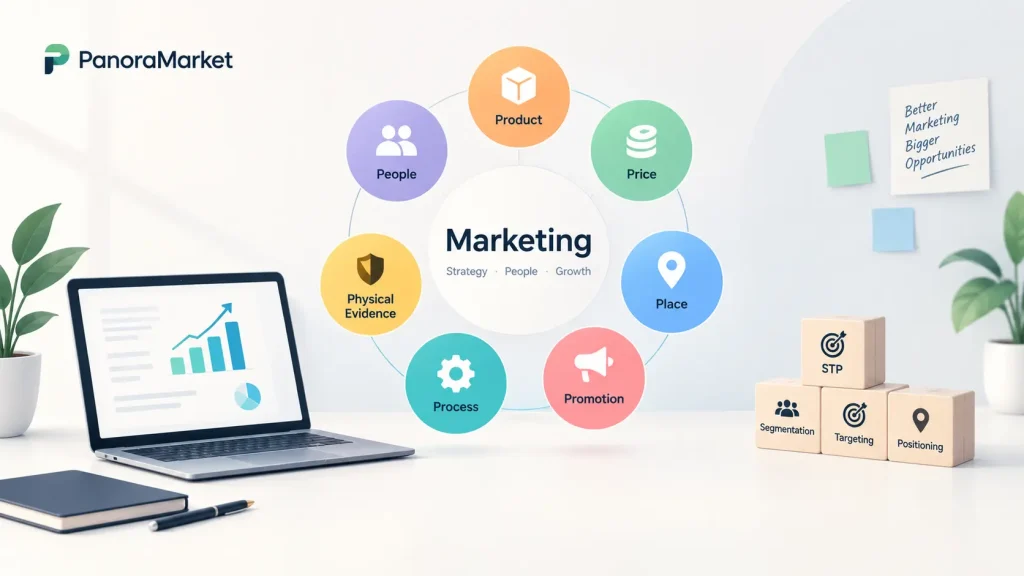
An introduction to the fundamentals of marketing, the marketing mix, and the STP framework.An introduction to the fundamentals of marketing, the marketing mix, and the STP framework.
Table of Contents
- What Is Marketing?
- The Marketing Mix: The 7Ps
- Segmentation, Targeting, and Positioning (STP)
- Marketing Is Much More Than the Marketing Mix and STP
- The Human Side of Marketing
1. What Is Marketing?
Let’s begin with Philip Kotler, widely regarded as one of the most influential thinkers in modern marketing.
Kotler describes marketing as the art and science of exploring, creating, and delivering value to satisfy the needs of a target market profitably. It involves identifying unmet needs and wants, defining the right market segments, assessing their size and potential, and determining where a business can create value more effectively than its competitors.
In essence, marketing helps a business understand where it can compete, whom it should serve, what value it should offer, and how that value should be delivered.
It provides a strategic roadmap for developing products and services that meet the needs of specific audiences and bringing those offerings to market in ways that create value for both customers and the business.
Marketing also plays an important role in capturing attention and engaging people intellectually and emotionally with a product, service, or brand.
In his broader conceptualization, Kotler describes marketing as a social and managerial process through which individuals and organizations obtain what they need and want by creating and exchanging value with others.
Let’s pause and look at these ideas again.
2. The Marketing Mix: The Building Blocks of Marketing Strategy
One of the foundational concepts in marketing is the Marketing Mix.
The traditional marketing mix consists of four elements, commonly known as the 4Ps:
- Product
- Price
- Place
- Promotion
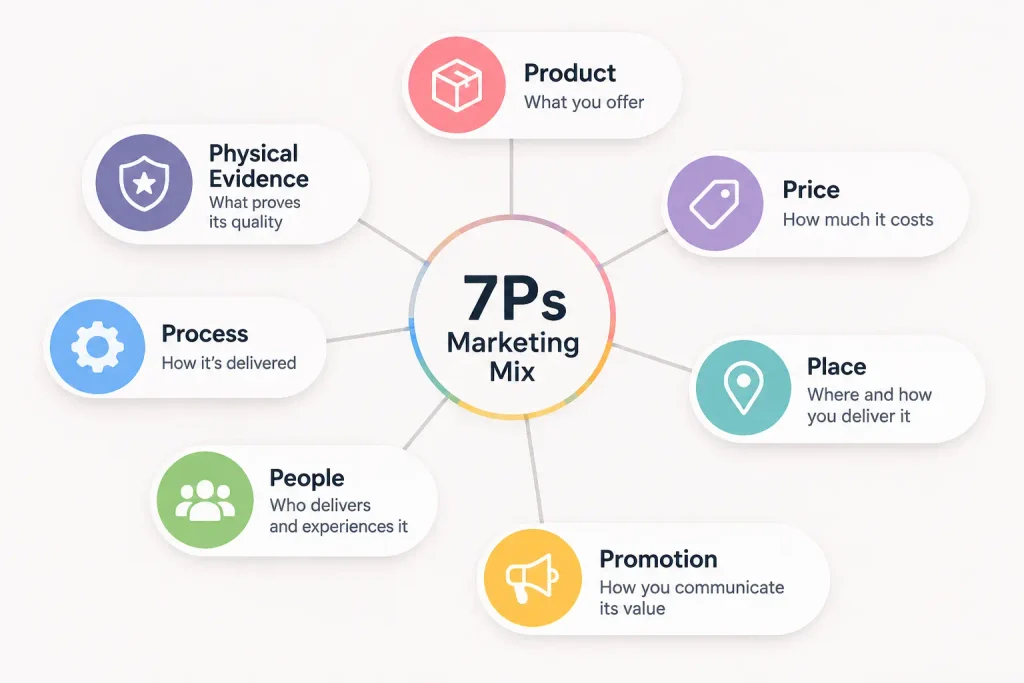
The framework was later extended to include three additional elements, particularly relevant to service businesses, resulting in the 7Ps of Marketing:
- Product
- Price
- Place
- Promotion
- People
- Process
- Physical Evidence
Although different industries and marketing frameworks may introduce additional considerations, the 7Ps remain a useful starting point for understanding how a business designs and delivers its market offering.
Let’s examine each element.
2.1. Product
A product is the offering through which a business delivers its core value. It can be a physical item, a service, or a combination of both.
To make sound product decisions, a business needs to answer several fundamental questions:
- What exactly are we offering?
- Whose needs does it address?
- What problem does it solve?
- What benefits does it provide?
- How is it different from competing alternatives?
- Why should customers choose it over other options?
Understanding the product means going beyond its technical specifications. It requires understanding the actual value customers perceive and the reasons they might choose one offering over another.
For example, people do not necessarily buy a smartphone simply because it has a particular processor or camera resolution. They may want convenience, creativity, status, entertainment, or a better way to stay connected.
The marketer’s job is to understand the relationship between product features, customer needs, and perceived value.
2.2. Price
Price is the amount a customer pays to obtain a product or service. However, pricing is much more than assigning a monetary figure to an offering.
A business needs to understand the value customers perceive, the costs of delivering the offering, the competitive environment, and its own commercial objectives.
Important pricing questions include:
- What makes this product worth its price?
- How much are customers willing to pay?
- What are competing products charging?
- Should we compete on affordability, differentiation, or premium value?
- How will pricing affect demand, profitability, and brand perception?
Different pricing strategies communicate different things about a product.
A premium price may reinforce perceptions of exclusivity or superior quality when the customer experience supports that promise. A competitive price may appeal to customers who prioritize affordability and practical value.
The right pricing strategy must align customer expectations, business economics, competitive conditions, and the brand’s intended market position.
2.3. Place
Place refers to how and where customers can access a product or service. It includes distribution channels, sales channels, availability, and the processes that make an offering accessible to its intended audience.
A business must consider questions such as:
- Where do customers expect to find the product?
- Should it be sold through physical stores, an online shop, or both?
- Which distributors or retail partners are appropriate?
- How will orders be fulfilled and products delivered?
- How can we make purchasing as convenient as possible?
For example, an online-first brand may reach customers through its website and selected marketplaces, while another business may rely on a network of physical retailers.
Even an excellent product can struggle if customers cannot find it, access it conveniently, or purchase it through channels they trust.
Place is therefore not merely about physical location. It is about making the right offering available to the right customers through the right channels.
2.4. Promotion
Promotion encompasses the activities through which a business communicates its offering, builds awareness, shapes perceptions, and encourages customers to take action.
The central question is simple: How will our target audience discover our product, understand its value, and become motivated to consider purchasing it?
Promotion can include advertising, public relations, sales promotions, content marketing, social media, email marketing, events, influencer partnerships, and personal selling.
Each channel serves different purposes and reaches audiences in different contexts.
A promotional strategy should therefore consider:
- Who needs to hear our message?
- What should they understand or feel?
- Which channels are most appropriate?
- What message and creative approach will resonate?
- What action do we want the audience to take?
- How will we evaluate the results?
Promotion is not simply about making noise in the marketplace. It is about communicating relevant value in ways that attract attention, build understanding, and encourage meaningful engagement.
The objective is not to reach everyone indiscriminately. It is to reach the people for whom the offering is relevant and help them recognize why it matters.
2.5. People
People refers to the individuals who contribute to delivering the customer experience. This includes employees, sales teams, customer service representatives, managers, and others whose actions influence how customers perceive a business.
Their knowledge, skills, behavior, communication style, and attitude can significantly affect customer satisfaction and brand reputation.
Businesses should consider:
- Who is responsible for delivering the customer experience?
- What skills and competencies do employees need?
- How should they be trained and evaluated?
- Who interacts directly with customers?
- What tone, behavior, and service standards should guide those interactions?
For example, a customer may evaluate a hotel not only by the quality of its rooms but also by the professionalism and responsiveness of its staff.
Similarly, a technically excellent product can generate a negative experience if customers receive poor guidance or inadequate support.
People are therefore an essential part of how a business delivers on its promises.
2.6. Process
Process refers to the procedures, systems, and workflows through which a product or service is created, purchased, delivered, and supported.
It includes both internal operations and the steps customers experience when interacting with a business.
Consider the following questions:
- How does a customer place an order?
- What happens after the order is received?
- How is the product prepared, delivered, or activated?
- How are complaints and service requests handled?
- How can the business make its processes faster, more reliable, and more convenient?
A well-designed process reduces friction, minimizes errors, and helps ensure a consistent customer experience.
For an e-commerce business, for example, the process may include product discovery, checkout, payment, order confirmation, fulfillment, delivery, and after-sales support.
Even small obstacles in these steps can discourage customers from completing a purchase or returning in the future.
Effective process design connects operational efficiency with customer satisfaction.
2.7. Physical Evidence
Physical evidence refers to the tangible cues and observable signals that help customers evaluate a business, particularly when the service itself is intangible.
These cues can include office buildings, store design, packaging, uniforms, printed materials, signage, and the appearance of the environment in which a service is delivered.
In today’s digital world, I would also argue that websites, mobile applications, and social media profiles deserve similar attention. Although these platforms are not physical objects in the traditional sense, they provide visible evidence of a business’s professionalism, reliability, and attention to detail.
A website that is accessible, well-organized, responsive, and easy to navigate can strengthen customer confidence. An outdated, confusing, or unresponsive website can undermine it.
The same principle applies to a physical store. Its cleanliness, layout, lighting, staff presentation, and overall atmosphere can influence how customers perceive the brand.
In both physical and digital environments, the experience should reflect the quality and values the business promises.
Putting the 7Ps Together
The seven elements should not be treated as isolated decisions. They work together to shape the overall market offering.
A premium product, for example, may require a pricing strategy that reflects its differentiation, distribution channels that reinforce its positioning, promotional messages that communicate its benefits, knowledgeable employees, reliable service processes, and an experience that supports its quality claims.
When these elements are aligned, they create a coherent marketing strategy.
Defining the marketing mix means establishing a clear, integrated approach to what a business offers, how much it charges, where customers can access it, how it communicates, who delivers the experience, how the offering is delivered, and what signals customers use to evaluate it.
Once these foundations are in place, the next question becomes: Which customers should we focus on, and how should we position ourselves in their minds?
This brings us to another fundamental marketing framework: STP.
3. STP: Segmentation, Targeting, and Positioning
STP stands for Segmentation, Targeting, and Positioning.
These three connected activities help a business understand the structure of its market, select the customer groups it can serve effectively, and establish a meaningful position relative to competing alternatives.
3.1. Market Segmentation
A strong marketing strategy begins with a sound understanding of the market.
Market research helps a business gather and analyze information about customers, competitors, market trends, consumer behavior, unmet needs, and purchasing preferences.
The purpose is not simply to collect data. It is to turn that data into useful insights that support better decisions.
Once a business has developed a clearer understanding of the market, it can divide the market into smaller groups of customers who share relevant characteristics, needs, or behaviors.
This process is known as market segmentation.
Common segmentation approaches include:
- Demographic segmentation
- Geographic segmentation
- Psychographic segmentation
- Behavioral segmentation
Businesses can also use needs-based segmentation to distinguish customers according to the problems they are trying to solve or the outcomes they want to achieve.
For example, a smartphone market might contain customers who prioritize affordability, customers who value photography, customers who need reliable business tools, and customers who seek high-performance gaming experiences.
These groups may overlap, but they differ in their priorities and the value they expect from a product.
Age or generation can also be useful segmentation variables. A business might investigate differences among Generation Z, Millennials, and Generation Alpha, for example. However, generational labels should be treated as starting points for research rather than assumptions about every individual within a group.
The central principle is that different customers can have different needs, motivations, expectations, and reasons for purchasing the same product.
Segmentation helps a business recognize these differences and develop more relevant marketing strategies.
Instead of communicating with everyone in the same way, a business can tailor its offering, messaging, channels, and customer experience to the characteristics of each relevant segment.
3.2. Targeting
After identifying and analyzing different market segments, a business must decide which of them it should prioritize.
This is the targeting stage.
Not every segment is equally attractive, and a business cannot necessarily serve every segment effectively. It must evaluate the opportunities available and determine where its resources and capabilities are most likely to create value.
Several questions are important:
- How large is the segment, and how much could it grow?
- What are its needs and purchasing power?
- How intense is the competition?
- Is the segment profitable or strategically valuable?
- Can our product genuinely satisfy its needs?
- Do we have the capabilities and resources to serve it?
- How much of this market could we realistically capture?
A business may choose to focus on a single segment, serve several distinct segments with tailored strategies, or pursue a broader market with a more standardized offering.
The right targeting decision balances market attractiveness with the business’s ability to compete and deliver meaningful value.
For example, a company may decide to prioritize a smaller, well-defined customer segment where it can build a strong competitive advantage rather than compete broadly against established market leaders.
3.3. Positioning
Once a business has selected its target market, it must decide how it wants its offering to be perceived relative to competing alternatives.
Positioning is the process of establishing a clear, distinctive, and meaningful place for a brand or product in the minds of its target customers.
Effective positioning answers three fundamental questions:
- Who is our target customer?
- What makes our offering different from competing alternatives?
- Why should customers choose us?
Positioning should be based on meaningful differences that matter to the target audience. These may relate to product performance, design, price, convenience, customer service, brand personality, or other attributes that influence customer choice.
For example, two smartphone brands may target similar customers but position themselves differently. One may emphasize camera innovation and creative expression, while the other focuses on battery life, reliability, and practical value.
A positioning statement helps clarify the intended position. It typically identifies the target audience, the category in which the offering competes, its main point of difference, and the reason customers should believe the promise.
Strong positioning provides direction for the entire marketing strategy. It influences product development, pricing, distribution, promotion, and the overall customer experience.
Putting STP into Practice
Segmentation, targeting, and positioning form a connected decision-making process. Segmentation helps a business understand customer differences, targeting determines which groups to prioritize, and positioning defines how the business wants to be perceived by those customers.
These decisions should be grounded in market research and a realistic assessment of the business’s capabilities. They should also remain flexible as customer needs, competitive conditions, and market opportunities evolve.
Ultimately, STP helps a business focus its efforts on the customers it can serve best and build a distinctive position that gives those customers a compelling reason to choose its offering.
4. Marketing Is Much More Than the Marketing Mix and STP
The marketing mix and STP framework offer a useful introduction to marketing, but they represent only part of the discipline.
Marketing encompasses a wide range of interconnected activities, including market research, consumer behavior, brand strategy, product marketing, pricing, customer experience, customer relationship management, marketing analytics, performance marketing, communications, and much more.
When these activities work together effectively, marketing can help strengthen the entire organization.
It can inform product development, reveal new market opportunities, improve customer relationships, guide resource allocation, and support sustainable business growth.
Marketing is not simply a department that promotes products after they have been developed. Ideally, it contributes to understanding the market before decisions are made and continues learning from customers after products and services reach them.
This is particularly important in a world where customer expectations, technologies, competitive environments, and purchasing behaviors are constantly evolving.
One of the most significant areas of modern marketing is Digital Marketing, which uses digital channels and technologies to reach audiences, communicate value, generate demand, and measure marketing performance.
Digital marketing has become an extensive discipline in its own right, encompassing areas such as search engine optimization, paid advertising, social media marketing, email marketing, content marketing, conversion optimization, and marketing analytics.
Each area has its own methods and tools, but all should ultimately contribute to a coherent marketing strategy rather than operate as disconnected activities.
5. The Human Side of Marketing: Understanding and Respecting Differences
There is one final aspect of marketing that I consider particularly important.
At its best, marketing recognizes that people are not identical.
They have different needs, values, aspirations, experiences, preferences, and ways of seeing the world. Even when people belong to the same demographic group or purchase the same product, the reasons behind their decisions may be very different.
Understanding these differences is not merely a technique for improving campaign performance. It is fundamental to creating meaningful value.
When businesses take the time to understand people, they can develop more relevant products, communicate more thoughtfully, and create experiences that reflect what genuinely matters to their customers.
This is why I believe good marketing begins with curiosity and respect.
It asks questions before making assumptions. It seeks to understand before attempting to persuade. And it recognizes that creating value requires more than broadcasting a message; it requires understanding the people who receive it.
This philosophy is also reflected in the thinking behind Panoramarket.
The idea is simple: every person has a distinct perspective, and those differences deserve to be recognized rather than ignored. In marketing, acknowledging individual differences allows us to understand diverse audiences and create value that is meaningful to them.
For me, this is one of the most compelling aspects of marketing. It brings together the analytical discipline of understanding markets and the creative challenge of connecting with people.
It is about discovering where a meaningful idea can make a difference, bringing that idea to life, and creating an exchange in which both the customer and the business gain something valuable.
And when the value promised is matched by the value experienced, marketing can do more than generate a sale. It can build trust, strengthen relationships, and contribute to the long-term vitality of a business.
Because, ultimately, marketing is not just about selling products. It is about understanding people, recognizing differences, and creating value that matters.